We live in an age when political strife has seemingly overtaken our country. The division between the political right and left has grown increasingly troubling. Republicans and Democrats hold sharply different views on issues such as protecting the unborn, providing healthcare for those who cannot afford it, feeding the poor, and determining the proper role of government in distributing wealth.
Yet I believe there is a greater problem facing our nation than political disagreement. It is the growing unwillingness to hold our political leaders morally accountable.
Regardless of which political party occupies the White House, there always seem to be individuals willing to defend a president despite serious moral failures. Instead of addressing wrongdoing, some supporters circle the wagons, rationalize questionable conduct, or remain silent.
As a Christian and pastor, I find this deeply concerning.
Where are the prophets of the Old Testament in our modern-day churches? Where are the voices willing to confront political power with biblical truth?
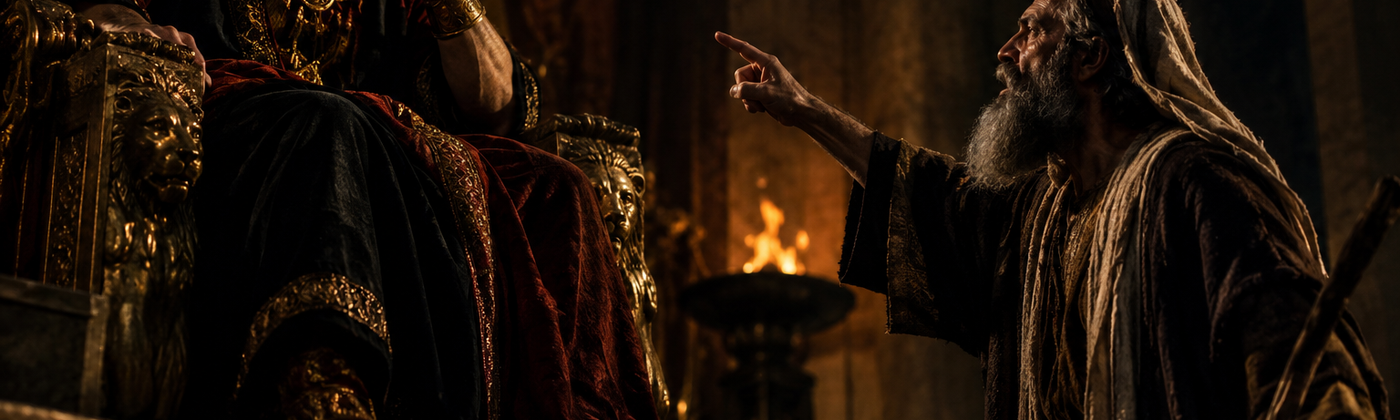
In 2 Samuel 12:1–14, the prophet Nathan confronted King David concerning his adultery with Bathsheba and his responsibility for the death of her husband, Uriah the Hittite. David had attempted to conceal his wrongdoing, but Nathan courageously confronted him through a parable that exposed his sin.
David ultimately acknowledged his transgression and repented before God.
Nathan did not excuse David's behavior because he was God's anointed king. He did not remain silent because David occupied a position of authority. Instead, he confronted the king with the truth.
Why, then, do we sometimes witness Christian leaders hesitate to confront political figures whose conduct contradicts the biblical values they profess to uphold?
Are we to believe that God overlooks moral compromise simply because a political leader supports policies that align with our religious convictions?
Scripture repeatedly reminds us that God is not mocked and that humanity ultimately reaps what it sows (Galatians 6:7).
I fear that our political culture has increasingly taken on characteristics of unquestioning loyalty. Political figures can become objects of admiration to such an extent that their supporters struggle to acknowledge their failures.
Yet I firmly believe that Christians can support political leaders and their policies while simultaneously holding them accountable to biblical principles. Political agreement should never require moral silence.
In Isaiah 5:20–23, the prophet condemned those who called evil good and good evil. He spoke against moral corruption, drunkenness, bribery, and the perversion of justice. Isaiah recognized the danger of a society that had abandoned moral discernment.
Similarly, Amos 5:21–24 records God's rejection of religious observances disconnected from righteousness and justice. Outward worship could not substitute for genuine obedience to God.
These passages should cause us to examine not only our political institutions but also the spiritual condition of the modern church.
As I observe public discourse, I am troubled by how frequently thoughtful debate has been replaced by personal insults, hostility, and attacks on character. Our disagreements have become increasingly personal, while our commitment to humility and moral consistency appears to have weakened.
I believe we must ask ourselves whether political identity, material interests, and personal loyalties have begun occupying places in our hearts that belong to God alone.
Jesus declared in Matthew 22:21 that we should render to Caesar the things that are Caesar's and to God the things that are God's.
This distinction reminds us that earthly governments have legitimate responsibilities, but they are not ultimate authorities over the Christian conscience. No political institution can provide the complete redemption and restoration that Scripture promises through Jesus Christ.
Our responsibility as Christians is not to place unquestioning confidence in political leaders but to remain faithful to God amid political turmoil, cultural conflict, and moral uncertainty.
When hatred captures our minds and bitterness grips our hearts, we risk compromising the very faith we claim to defend.
I have watched religious leaders publicly defend politicians while appearing reluctant to address conduct that deserves serious moral examination. I believe such situations raise important questions about the relationship between political influence, religious leadership, and biblical accountability.
These concerns should apply equally to Republicans and Democrats, presidents and members of Congress, pastors and ordinary believers.
None of us is perfect. All have sinned and fallen short of the glory of God (Romans 3:23). We are saved by grace, not by our own righteousness.
But grace does not eliminate accountability, and forgiveness does not require us to ignore wrongdoing.
The church must never confuse loyalty to a political leader with faithfulness to Jesus Christ.
Perhaps the question facing our generation is not simply whether our political leaders are willing to listen to correction.
Perhaps the greater question is whether our spiritual leaders are willing to speak when correction is necessary.
Where are the Nathans, the Isaiahs, and the Amoses of our generation?

About the Author
Joshua Capilla
Founder of The Capilla Report | Author | Pastor | Christian Counselor | Documentary Producer
Joshua Capilla is an American author, Christian pastor, counselor, and documentary producer whose work spans biblical theology, pastoral counseling, cultural analysis, and contemporary issues. He holds a Master of Arts in Pastoral Care and Counseling from Ohio Christian University and is the founder of The Capilla Report — an independent publication dedicated to exploring theology, politics, culture, and the important questions shaping modern society.
Read full biography →Joshua Capilla
Founder & Editor, The Capilla Report