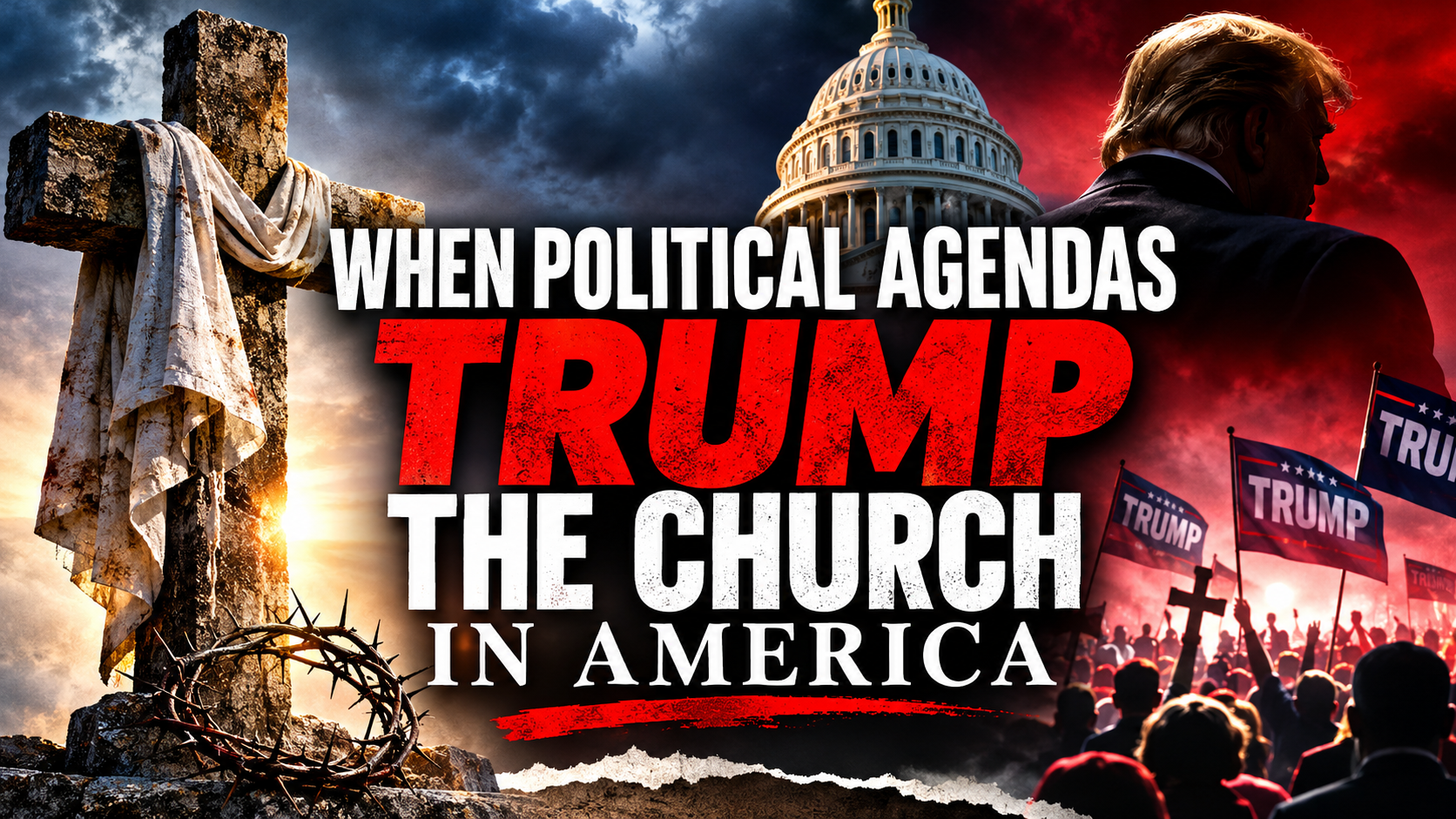
When Political Agendas Trump the Church in America
The evangelical church's alliance with partisan politics has cost it something no election can restore.
There has been a growing notion in America that evangelical churches should endorse political figures and align themselves with political movements. From Franklin Graham to Paula White, whom I consider a false teacher, and a host of other religious leaders claiming the sacred authority of Christ, we have witnessed an alarming marriage between politics and Christianity.
I do not believe America has witnessed a political figure as polarizing as Donald J. Trump in the last 40 or 50 years. Across the country, evangelical Christians gathered in churches, attended political rallies, and listened to sermons from pulpits proclaiming that Trump was the man chosen to save America.
But save America from what? And more importantly, at what cost to the Christian church?
While evangelical leaders rallied around their chosen political champion, millions of Americans watched a very different testimony unfold on national television. They watched President Trump berate female journalists for asking legitimate questions. Women were subjected to insults such as "piggy" and "stupid." Political opponents and critics were routinely demeaned, ridiculed, and dismissed. Americans struggling with the cost of living were confronted with political rhetoric that often appeared disconnected from their daily suffering.
Meanwhile, the nation faced war, economic uncertainty, rising costs, and the terrifying possibility of nuclear escalation. And where was the moral accountability from those who claimed to represent Jesus Christ?
I have spent many years of my life involved in Christian ministry. I have also spent many years involved in politics. Throughout that time, I have remained both fascinated and deeply disappointed by how quickly some Christians abandon their moral principles when they become starstruck by a politician whose conduct contradicts the very teachings of Christ.
Consider Romans 2:24: "For the name of God is blasphemed among the Gentiles through you." These words should shake the conscience of every Christian who claims to represent the gospel.
We are supposed to be agents of Christ, ministering to the lost, demonstrating love, and proclaiming the truth. As Christians, we have an obligation to confront wrongdoing, especially when someone professes the name of Christ while disparaging, demeaning, and denouncing others. We are not called to surrender our moral convictions simply because someone promises to advance our political agenda.
Yet I have watched politicians become idolized, their personalities elevated above accountability, and movements develop around individuals who seemingly can do no wrong in the eyes of their followers.
Let me make something clear: I have voted for Republicans and Democrats throughout my lifetime. I do not believe either political party possesses a monopoly on morality, righteousness, or truth.
But during this political era, I watched a president use the national stage to rail against Americans who dared to disagree with him. Then, on Sunday, I watched portions of the evangelical church defend him, excuse his conduct, and continue offering their unwavering support. What I witnessed disturbed me.
When did we stop standing up for truth? When did we stop standing up for morality? When did political loyalty become more important than Christian character?
I have heard the familiar argument that the Democratic Party does not represent God and is destroying America. Yet many of the same people making that accusation have embraced a Republican political movement that claims the mantle of Christianity while demonstrating conduct that contradicts the teachings of Christ.
Jesus warned us that no man can serve two masters. He also asked whose image and inscription appeared on the coin when addressing the relationship between earthly authority and our obligations to God. The message should be unmistakable: earthly political power must never replace our allegiance to God.
This does not mean Christians should abandon politics, refuse to vote, or withdraw from the public square. Quite the opposite. We should participate in government, advocate for meaningful change, promote stability, and hold elected officials accountable. But meaningful change requires confronting our leaders with truth, even when that truth is politically inconvenient.
Truth should never be sacrificed to satisfy our anger, our political desires, or our obsession with a particular leader.
The Election and the Evangelical Reckoning
The 2026 midterm elections delivered a sweeping political rebuke to President Trump and the Republican Party. Democrats captured control of both chambers of Congress, reversing Republican political fortunes and demonstrating widespread dissatisfaction with the direction of the country.
But I believe something deeper occurred. I believe this election was also, at least in part, a rebuke of the evangelical church and its political alliances.
Not every voter consciously entered the voting booth intending to rebuke Christianity. Nevertheless, I believe many Americans — including atheists, agnostics, independents, and those who have distanced themselves from organized religion — witnessed the contradiction between the message of Christ and the conduct of political leaders embraced by influential evangelicals.
They saw religious leaders defending behavior they would ordinarily condemn from their own pulpits. They witnessed political loyalty replacing moral accountability. And perhaps, even subconsciously, they began associating the evangelical church with the very behavior they found reprehensible.
I am not here to condemn either political party in its entirety. I am here to argue that when evil becomes evident, Christians have an obligation to stand firm upon the principles of the gospel. That does not mean we hate anyone. It means we tell the truth.
Truth is not subject to raw emotion, misplaced loyalty, or the abandonment of intellectual and spiritual discernment. Americans should expect more from their political leaders, especially those who publicly profess Christianity.
How can we effectively witness to a nation while publicly attacking the very people we are commanded to love? How can we proclaim the transforming power of Jesus Christ while refusing to demonstrate that transformation in our own conduct?
I believe Christianity's public witness has been seriously damaged by religious leaders who aligned themselves with a political movement while refusing to consistently practice the principles they preached. An extraordinary opportunity was missed.
Instead of demonstrating humility, repentance, forgiveness, and love, the national conversation became consumed by political power. And now, following the election, what do we hear? How will Republicans recapture the House? How will they regain the Senate? What will happen in the next presidential election? Once again, the central message has been lost. What about the Great Commission? What about the souls of the lost? What about the credibility of the church?
When Political Power Replaces Spiritual Authority
As a Christian pastor and author, I cannot fully identify with either political party. I can, however, work with individuals from both parties to pursue meaningful change while remaining faithful to my convictions. I do not need to hate someone because we disagree. I do not need to abandon my faith to participate in government. And I certainly do not need to worship a politician to defend my country.
Politics has been consumed by hatred, rage, division, and a profound absence of love for decades. I believe political figures such as Vice President JD Vance and Secretary of State Marco Rubio face an enormous challenge in convincing Americans that they possess the moral courage necessary to lead the nation.
How can political leaders establish their independence and integrity when they have been unwilling to meaningfully confront wrongdoing within their own political movement? Leadership requires more than loyalty. It requires character. It requires conviction. And sometimes, it requires the courage to stand against the very people who helped elevate you to power.
Even atheists and agnostics can recognize moral hypocrisy. One does not need to profess Christianity to recognize when religious leaders abandon the principles they claim to defend. And that is perhaps one of the greatest tragedies of this entire political movement.
People who might otherwise have been receptive to the gospel may now associate Christianity with political hostility, hypocrisy, and unconditional loyalty to a man. We have risked closing the very doors we were commissioned to open.
The opportunity to share the gospel was placed before a nation, yet too often it was squandered in pursuit of political influence. What should have been a testimony of Christ became, in my view, an unholy relic of political ambition that no amount of religious rhetoric could sanctify.
Can this damage be reversed? I believe it can, but it will require men and women of genuine character to stand up, confront the truth, and begin uniting Americans despite their differences.
Christianity Is Not Republicans Against Democrats
As Christians, our ultimate spiritual struggle is not Republicans against Democrats. It is Christ against Satan, righteousness against wickedness, and truth against deception. Jesus taught that people would be known by their fruits. Matthew 7:16 declares: "Ye shall know them by their fruits."
If the only fruit we produce as an evangelical movement is hatred toward Democrats, Republicans, independents, or anyone who disagrees with us, then we have fundamentally misunderstood our mission.
The Republican Party has increasingly wrapped itself in the mantle of Christ, Scripture, and biblical authenticity, while portions of its movement have seemingly left love, humility, and goodwill behind.
I am conservative in my social values, including my convictions regarding abortion, marriage, and the biblical understanding of male and female. I will not apologize for those convictions. But neither will I use them as justification to demean, humiliate, or hate another human being. I can disagree with someone while still loving that person. I can oppose a policy without attacking the dignity of those who support it. And I can stand firmly upon biblical truth without surrendering my Christian witness to political anger.
The church must remember that its primary responsibility is not to control the world but to remain faithful to Christ. The apostle Paul instructed believers to exercise judgment within the church rather than assume responsibility for judging the entire world. That does not prohibit Christians from participating in public life. It reminds us that the church must first examine its own conduct before demanding righteousness from everyone else.
We must recognize that no political movement will transform a fallen world into the Kingdom of God. That is not the responsibility of the Republican Party. It is not the responsibility of the Democratic Party. And it certainly is not the responsibility of Donald Trump. Christians believe that the ultimate restoration of this world belongs to Jesus Christ.
Trying to force righteousness through hatred and political domination is like attempting to draw fresh water from a poisoned well and then drinking it. The water remains poisoned, regardless of how desperately we wish it were pure. No politician should ever become our savior, our ultimate hope, or a vessel into which we pour our anger and hatred before declaring those emotions righteous.
The Church Must Answer for Its Witness
I want to be absolutely clear. I do not hate Donald Trump. I wish him no harm. I believe he, like every other human being, needs the grace, mercy, and forgiveness of Jesus Christ.
But I also believe portions of the evangelical church will suffer lasting consequences for attaching their spiritual identity so closely to the Republican Party while refusing to confront conduct that contradicted their own teachings.
The Democratic Party has moral and political failures of its own to answer for. No political party is exempt from accountability, and no party can claim exclusive ownership of God. My central concern is the appropriation of Christ's name by political movements whose actions often reveal a disturbing absence of the love He commanded.
As Christians, we will never find our ultimate answers in either political party. Our calling is greater than an election. Our mission is greater than a presidency. And our responsibility to the gospel is greater than the political ambitions of any man or woman.
If the evangelical church wishes to restore its credibility, it must stop confusing political victory with spiritual faithfulness. It must rediscover the courage to confront wrongdoing, even when that wrongdoing comes from its political allies. It must demonstrate that Christian love is not conditional upon party registration, ideological agreement, or personal loyalty.
And above all, it must remember that Jesus Christ did not commission His disciples to build a political empire. He commissioned them to make disciples. The church may have gained access to political power, but what has it sacrificed in spiritual authority? That is the question American evangelical leaders must now confront.

About the Author
Joshua Capilla
Founder of The Capilla Report | Author | Pastor | Christian Counselor | Documentary Producer
Joshua Capilla is an American author, Christian pastor, counselor, and documentary producer whose work spans biblical theology, pastoral counseling, cultural analysis, and contemporary issues. He holds a Master of Arts in Pastoral Care and Counseling from Ohio Christian University and is the founder of The Capilla Report — an independent publication dedicated to exploring theology, politics, culture, and the important questions shaping modern society.
Read full biography →